Why cancer prevention is not just about personal choices
March 9, 2026
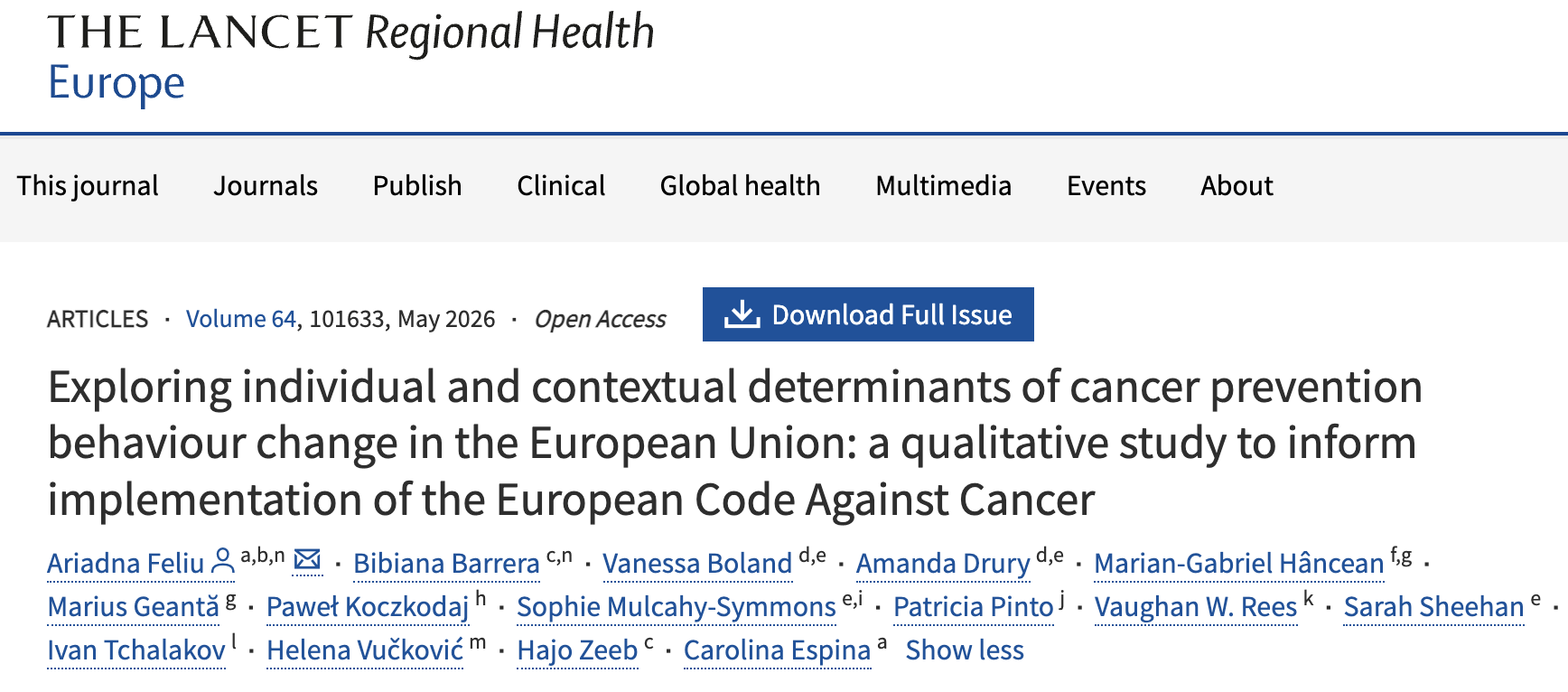
Our team has recently published a new study in The Lancet Regional Health – Europe exploring a simple but important question: if many cancers are preventable, why is it still so difficult for people to change their behaviour?
Every year, millions of people in Europe are diagnosed with cancer. Yet research shows that around 40% of cancer cases could be prevented by reducing exposure to known (social) risk factors such as smoking, alcohol, unhealthy diets, physical inactivity, and environmental hazards. But if we know the risks, why do not we simply change our behaviour?
In this new multi-country qualitative study, we explored this question by talking directly with people across Europe about the European Code Against Cancer (i.e., a set of evidence-based recommendations designed to help individuals reduce their cancer risk). Researchers interviewed 141 adults from nine EU countries, including Romania, Germany, Spain, Ireland, and Portugal, to understand what helps or prevents people from following these recommendations. The results reveal something important: most people want to live healthier lives, but the context around them often makes it difficult.
Motivation is not the main problem
Many participants said they were motivated to take care of their health. Fear of cancer, seeing loved ones suffer, or wanting to stay healthy for their children often pushed people to think about prevention. In fact, the study found that motivation was often strong. People generally understand that healthier lifestyles are beneficial, and many expressed a desire to live longer, healthier lives. Nevertheless, motivation is rarely enough.
Knowledge gaps still matter
One barrier identified in the study was health literacy — simply knowing what risks exist and what to do about them. Many participants were unfamiliar with certain cancer risks, such as exposure to radon gas at home or carcinogenic substances (tobacco smoke, alcohol, asbestos, benzene, etc.) in the workplace. Others were unsure where to find trustworthy information or professional advice. Participants frequently suggested that health education should start earlier in schools, helping people develop the knowledge and skills needed to make informed health decisions later in life.
Our environments shape our behavior
One of the most important findings of the study is that social and structural factors strongly influence health behavior. People described many practical barriers:
- Healthy food can be more expensive than processed alternatives;
- Busy schedules and long working hours leave little time for exercise;
- Cancer screening services may be far away or difficult to access;
- Social norms, such as drinking alcohol during celebrations, create pressure to follow unhealthy habits.
In other words, the environment around us often pushes us toward unhealthy choices, even when we know better.
Social networks matter more than we think
Health behaviors rarely happen in isolation. Family, friends, and social circles strongly influence whether people adopt healthier habits. Supportive environments, such as friends encouraging someone to quit smoking, can make change easier.
But social pressure can also work in the opposite direction. Participants described situations where refusing alcohol or unhealthy food made them feel judged or labeled as "too health-conscious". This reminds us that health behavior spreads through social networks, much like ideas and habits.
Prevention needs more than individual responsibility
One of the key conclusions of the study is that cancer prevention cannot rely only on personal willpower. Even when people are motivated, structural barriers — such as financial constraints, limited access to healthcare services, or unhealthy environments — can make prevention difficult.
Effective cancer prevention therefore requires action at multiple levels:
- improving health literacy;
- ensuring equitable access to screening and vaccination;
- creating healthier food and physical environments;
- strengthening public policies that support healthy behavior.
In short, healthy choices should also be the easy choices.
Why this research matters
The insights from this study will help inform the upcoming 5th edition of the European Code Against Cancer, ensuring that recommendations are not only scientifically sound but also realistic and actionable for people living in different contexts across Europe.
Cancer prevention is often framed as a matter of personal responsibility. But this research reminds us that health is shaped by a complex web of knowledge, social norms, resources, and opportunities. If we want to prevent cancer at scale, we must think not only about changing individuals but also about changing the environments in which people live, work, and make decisions about their health.
© 4P-CAN Project. All rights reserved. Design: Bogdan Vidrașcu based on a template from HTML5 UP.